

Mothers have always worked
Reflections for making peace in the mummy wars.
Should mothers work? That’s the question at the heart of the so-called ‘mummy wars’, which have sought to divide ‘working mums’ from ‘stay-at-home mums’. This article is an excerpt from my chapter of Parenting in God’s Family Volume 2 and offers some reflections that might help us to bridge the divide between ‘work’ and ‘home’ and imagine a more biblical integration of these two spheres of life.
This topic can stir up some very strong emotions. It doesn’t take much to make a mother feel guilty about what she has or hasn’t done for her children (or her career). But it’s important to say at the outset that we are all bound by the particular circumstances we find ourselves in—all we can do is make the most of them. In today’s economy, many mothers have very little choice about when or whether to return to paid employment.
All of us, however we’ve managed to ‘juggle’ raising children with paying the bills, have to entrust our children—and our bills!—into God’s strong and loving hands. No mother is perfect or perfectly present for her children, but all mothers can turn to Jesus who said:
Come to me, all you who are weary and burdened, and I will give you rest. Take my yoke upon you and learn from me, for I am gentle and humble in heart, and you will find rest for your souls. (Matthew 11:28–29)
What is work?
To begin with it’s important to recognise that in God’s eyes, there is no distinction between paid work and the rest of life. Human beings have a creation mandate: God created us for the ‘work’ of filling, ruling and caring for creation as his image-bearers (Genesis 1:26–28; Genesis 2:15). Christians also have a gospel mandate: we have been re-created for the ‘work’ of loving God, loving our neighbours and sharing the good news about Jesus (Matthew 22:37–39; Matthew 28:19–20).
It’s not wrong to do these things for money—after all, ‘the worker deserves his wages’ (1 Timothy 5:18). But if we do these things as a volunteer—for our own family or church community—it still counts as valuable ‘work’ in God’s eyes.
In the modern economy, ‘real’ work is done for strangers in exchange for money. In economic terms, working in a childcare centre looking after other people’s children is considered ‘work’; but staying home to care for your own child is not. By contrast, in God’s economy, ‘work’ that is done out of love for people we know brings him great glory, because we are living out our God-given purpose—even if it brings us no earthly reward.
Motherhood is not just a ‘job’. It’s not about function but relationship: it binds us to particular people—our own children. Children need their mothers close, especially in the first three years: mothers may be replaceable at work, but not at home. Being present and attentive to our own children and creating a nurturing home for them is the invaluable work of motherhood (for more about this, see my chapter of Parenting in God’s Family Volume 2).
How pre-industrial mothers worked
Our modern economy has separated the spheres of ‘home’ and ‘work’. Home is generally only a place of rest and recreation—where things are consumed rather than produced. This has resulted in the dichotomy that started the ‘mummy wars’: either you ‘go out’ to work or you are a ‘stay-at-home’ mother.
However, this sharp division is fairly recent; before the Industrial Revolution, most homes were also ‘workplaces’. Families ran farms, shops and small businesses from their home bases. They also grew, cooked and preserved food; they sewed, knitted and repaired clothes. Families were not just bound by affection and recreation—they were also economic units: mothers and fathers, sons and daughters all contributed to the family’s ‘work’.
This model allowed mothers (and fathers!) to integrate the various kinds of ‘work’ that human beings were created to do. They could ‘fill the earth’ by giving birth to and raising their own children at the same time as ‘working’ the creation for food and clothing and serving their neighbours through their family business. Men and women still had their distinct areas of focus, but there was much more crossover and collaboration.
The mothers we meet in the Bible also lived in a society where motherhood was not cut off from other kinds of productive work. For example, the famous ‘wife of noble character’ in Proverbs 31 makes food and clothing for her household, sells surplus garments for profit, invests in productive real estate, manages employees and gives to the poor (Proverbs 31:10–31). Widows in the early church were expected to have done numerous good deeds including ‘bringing up children, showing hospitality, washing the feet of the Lord’s people, [and] helping those in trouble’ (1 Timothy 5:10).
In all likelihood, these ancient mothers often had their children with them as they worked—they were simultaneously ‘working’ and caring for and teaching their children. It’s true that in Bible times, wealthier families employed nurses to help with childcare and servants to help with housework. But even then, the division between domestic life and work would have been fairly porous. Children were not seen as hinderances to work, but as apprentices who watched and learned.
This helps us to put into perspective Paul’s encouragement to young women ‘to love their husbands and children, to be self-controlled and pure, to be busy at home’ (Titus 2:4–5). These wives weren’t just busy changing nappies and doing housework, but they were also likely involved in home-based, income-producing work.
This all changed when the Industrial Revolution took most productive work out of the home—and the ‘workers’ with it. New technologies enabled goods to be produced on an industrial scale, so fathers began to leave home to work in large factories and businesses. Mothers were left behind to do the ‘non-productive’, unpaid work of caring for children (and parents) and running the household. Even the work of producing food and making clothing began to be outsourced to industrial farms and factories.
All of this meant that most mothers were no longer economically ‘productive’ co-workers with their husbands—they were left at home alone with their children and their unseen, unpaid labour of love. If they wanted to have a ‘real’ paid job, they would have to leave their children in the care of others.
Our grandmothers’ careers
It was this kind of world that our grandmothers lived in, where many women did not do any paid work after getting married (needless to say, their families were able to survive on one single income!).
Our grandmothers may have been ‘unemployed’, but they were not unproductive. They were busy living out their ‘creation mandate’: cultivating gardens and preserving the produce; making clothes, quilts and blankets; cooking meals to share; writing poetry. They were also living out their ‘gospel mandate’ of loving their neighbour: looking after other people’s children; teaching children about God in schools and churches; running ‘auxiliary’ groups to support local hospitals; starting clubs. And some of them did have paid jobs—mostly nursing and teaching in the local community.
By ‘staying home’, most of our grandmothers had more time for developing relationships within their local community. Mothers were the ‘eyes on the street’ that looked out for the welfare of all children. Even those mothers who did work tended to have relational, community-based roles. For generations, mothers have stood at the heart of a network of relationships that started with their own families and stretched out into the wider community.
A biblical re-integration
We’ve seen that in God’s eyes, all work is valuable. Whether we are ‘filling the earth’ by having and raising children, whether we are ‘working’ the creation to make useful and beautiful things or whether we are serving our neighbours for the love of God or sharing with them the gospel of Jesus, it all brings glory to God.
We’ve seen that children need their mothers close, especially in the first three years. But we’ve also seen that in previous generations, caring for children was not incompatible with other forms of work.
Mothers have always worked! Whether that’s doing the irreplaceable work of motherhood, the productive work of a household farm or business, or the voluntary (or paid) work of caring for others in their neighbourhood, church or school community. The big difference is that women of previous generations were able to do these things with their children nearby—they didn’t have to leave them in the care of paid strangers. They were working and mothering at the same time.
The big question for modern mums is not should mothers work, but rather how can we find paid work that complements, rather than undermines the invaluable work of motherhood. How can we better integrate the spheres of home and work in a way that will bring blessing to our own families—blessing that will spill out into communities where God has placed us.
To read more about how we can do this, see my chapter of Parenting in God’s Family Volume 2.
You can also listen to a conversation that my co-contributor Andrew Horsfield and I recently had about mothers, fathers, work and discipleship on the HerTheology podcast.
---
Harriet Connor is the Content Editor for Growing Faith and the editor of the two volumes of Parenting in God's Family: Biblical Wisdom for Everyday Issues. She is the author of Families in God's Plan: 12 Foundational Bible Studies (Youthworks Media, 2021) and Big Picture Parents: Ancient Wisdom for Modern Life (Wipf and Stock, 2017). She lives on the Central Coast of NSW with her husband and four sons.
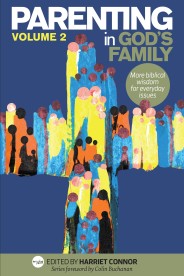
Parenting in God's Family Volume 2
This second volume of Parenting in God’s Family goes deep into topics that concern Australian Christian parents. The 21 authors bring biblical wisdom and their different first-hand experiences together to show how parents today can apply God’s word to the joys and challenges of parenting.
For more articles from Growing Faith, subscribe to our monthly e-newsletter.
To hear about the latest books and resources from Youthworks Media, subscribe here.
Related Posts: